Read, Sort and Print Array in C
Introduction to Array Functions in C
Assortment Functions in C is a type of data structure that holds multiple elements of the same information type. The size of an assortment is fixed and the elements are collected in a sequential manner. There can exist different dimensions of arrays and C programming does not limit the number of dimensions in an Array.
Dissimilar Functions of Array in C
There are different functions that can exist performed on arrays.
one) Traversing
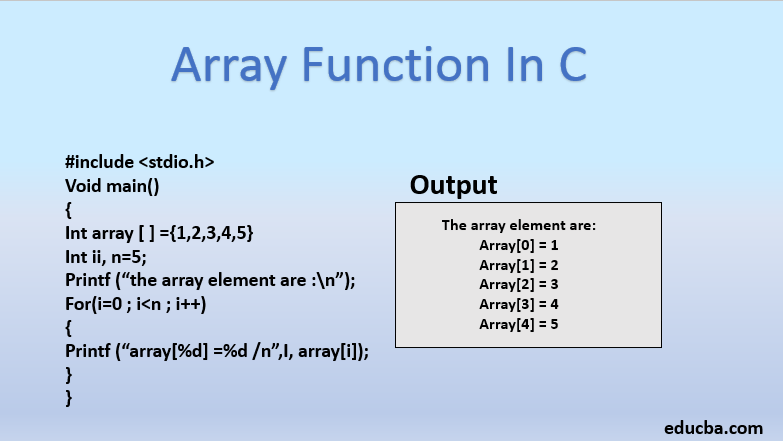
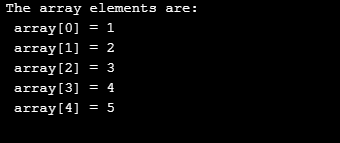
Traversing an Array ways going through each element of an Assortment exactly once. Nosotros first from the first element and become to the final element. An example of such a plan that performs traversing functioning on a linear Assortment is given beneath in C linguistic communication.
Lawmaking:
#include <stdio.h>
                void main()
                {
                int assortment[] = {one,ii,iii,4,five};
                int i, northward = 5;
                printf(" The array elements are: \n " );
                for( i=0;i < n; i++)
                {
                printf(" assortment[%d] = %d \due north " , i, array[i] );
                }
                }
Output:
2) Searching
The search performance is used to find a particular information item or element in an Array. We can perform searching in an unsorted array with the help of traversal of the Array. The linear traversal from the outset chemical element to the last element can be used to search if a given number is present in an Array and tin too be used to observe its position if nowadays.
This is washed by comparing each chemical element with the given element (which is to be searched). Once the element is found, the search operation is stopped. Here is an example to show search operation performed on an Array in C
Code:
#include<stdio.h>
                int findElement(int arr[], int northward,  int fundamental)
                {
                int i;
                for (i = 0; i < n; i++)
                if (arr[i] == key
                return i;
                render -1;
                }
                int principal()
                {
                int arr[] = {ane, iv, 0, six, 3};
                int northward = sizeof(arr) / sizeof(arr[0]);
                int primal = iv;
                int position = findElement(arr, n, primal);
                if (position == - 1)
                printf("Element not found");
                else
                printf("Element Found at Position: %d", position + 1 );
                return 0;
                }
Output:

3) Insertion
Insertion performance is used to add a new chemical element in the Array. When we specify the item element and position where it is to be added in the Array, we perform insertion operation. Withal, the size of the Array is not disturbed while performing this operation. An element will be inserted in an array only if it has sufficient space to add together it. If the size of an assortment is full already, a new element cannot be added. An instance to bear witness insert operation in an unsorted Array in C.
Lawmaking:
#include<stdio.h>
                int insertSorted(int arr[], int n,  int key, int capacity)
                {
                if (n >= capacity)
                return n;
                arr[n] = key;
                render (n + one);
                }
                int main()
                {
                int arr[20] = {8, five, 6, 9, 0, 7} ;
                int capacity = sizeof(arr) / sizeof(arr[0]);
                int n = 6;
                int i, fundamental = 2;
                printf("\n Before Insertion: ");
                for (i = 0; i < northward; i++)
                printf("%d  ", arr[i]);
                n = insertSorted(arr, n, key, chapters);
                printf("\n Subsequently Insertion: ");
                for (i = 0; i < north; i++)
                printf("%d  ",arr[i]);
                return 0;
                }
Output:

4) Deletion
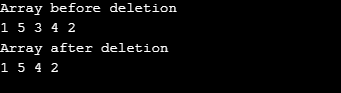
In delete operation, the element which already exists in the Array is searched (using linear search) and deleted, followed past the shifting of elements. The user enters the position of the chemical element which is to be deleted from the array. Deletion operation, only like the insertion performance, does not affect the size of array. Also, the position of the element to be deleted should exist within the size of array, since the deletion of an element beyond the size of Array is non possible. C program to testify delete operation in an unsorted array.
Code:
#include<stdio.h>
                int findElement(int arr[], int n, int key);
                int deleteElement(int arr[], int n, int key)
                {
                int pos = findElement(arr, n, fundamental);
                if (pos == - 1)
                {
                printf("Chemical element not found");
                return n;}
                int i;
                for (i = pos; i < n - 1; i++)
                arr[i] = arr[i + 1];
                return n - i;
                }
                int findElement(int arr[], int n, int key)
                {
                int i;
                for (i = 0; i < northward; i++)
                if (arr[i] == primal)
                render i;render - ane;
                }
                int main()
                {
                int i;
                int arr[] = {1, five, 3, iv, ii};
                int n = sizeof(arr) / sizeof(arr[0]);
                int key = 3;
                printf("Array before deletion\due north");
                for (i = 0; i < n; i++)
                printf("%d  ", arr[i]);
                n = deleteElement(arr, due north, key);
                printf("\nArray later on deletion\north");
                for (i = 0; i < due north; i++)
                printf("%d  ", arr[i]);
                return 0;
                }
Output:
5) Sorting
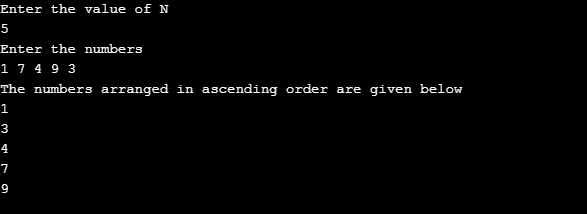
This operation is performed to sort an Array into a fixed order, i.east., either ascending or descending. Here is an example of sort operation on an Assortment in C
Code:
#include <stdio.h>
                void main()
                {
                int i, j, a, due north, number[30];
                printf("Enter the value of N \northward");
                scanf("%d", &north);
                printf("Enter the numbers \northward");
                for (i = 0; i < north; ++i)
                scanf("%d", &number[i]);
                for (i = 0; i < due north; ++i)
                {
                for (j = i + 1; j < north; ++j)
                {
                if (number[i] > number[j])
                {
                a =  number[i];
                number[i] = number[j];
                number[j] = a;
                }
                }
                }
                printf("The numbers bundled in ascending order are given below \n");
                for (i = 0; i < n; ++i)
                printf("%d\n", number[i]);
                }
Output:
Different ways of Sorting an Array
Below are the different sorting methods for Array:
1) Bubble Sort
Bubble sort compares all the elements one by one and sorts them based on their values. It starts past comparing the first element with the second, if the first element is greater than the second element, information technology will swap both the elements, and carry on comparing the 2d and the third chemical element, so on.
ii) Selection Sort
The bones thought behind pick sort is finding the least chemical element in the unsorted assortment, replacing it with the commencement chemical element. And then go along the same process with the residual of the unsorted array, i.due east., from the 2nd position, then from the third and so on.
iii) Merge Sort
This method of sorting is based on the divide and conquer technique. Information technology splits the array into two equal subarrays and continues until each subarray contains a single element, and then merges them in a sorted manner resulting in a sorted array.
4) Insertion Sort
In insertion sort, we start with the 2nd element. The array elements are compared with each other in a sequential manner. The current element(the value to be sorted) is compared with all the elements in the sorted subarray. All the elements in the sorted subarray which are greater than the electric current chemical element are shifted, and the current value is inserted. This procedure is repeated until the whole array is sorted.
v) Quick Sort
Quicksort, simply like the merge sort, is also based on the divide and conquer algorithm. In this method, an element is picked equally the pivot (more often than not the first chemical element). And so, partitions of an array are made around the picked pivot i.e., all the elements less than the pivot will form one sub-array and all the elements greater than the pivot will course another. The procedure is repeated with the sub-arrays too until the whole array is sorted.
six) Heap Sort
The algorithm of heap sort is based on the comparison. The maximum element is selected and placed in the end position. And so the second largest element is establish and placed in the second concluding position. This process is repeated for all the elements.
Recommended Manufactures
This is a guide to Array Functions in C. Hither we hash out the basic concept and different functions and ways of sorting an Array respectively. You lot can also go through our other related articles to learn more –
- Arrays in C++
- Arrays in R
- Functions in R
- Advantages Of Assortment
Source: https://www.educba.com/array-functions-in-c/
0 Response to "Read, Sort and Print Array in C"
แสดงความคิดเห็น