The Making of Dead Again Movie

"Dead Again" is like "Ghost" for people who grew up on movies that were not afraid of one thousand gestures. This is a romance with all the stops out, a story about intrigue, deception and encarmine murder - and about how the secrets of the present are unraveled through a hypnotic trance that reveals the secrets of the past. I am a particular pushover for movies like this, movies that could go on the same listing with "Rebecca," "Wuthering Heights" or "Vertigo." MURDER! screams the first word on the screen. Headlines tell of a Hollywood scandal in the 1940s involving the expiry of the cute immature wife of a European composer. We cutting to the present twenty-four hours. The musical score by Patrick Doyle is ominous and insinuating.
We see a threatening old Gothic mansion, we meet a cynical private eye, there is a cute woman who has lost her retention, a stray hypnotist who wants to regress her in a search for clues. And of course, the murder in the 1940s holds the clue to the woman'due south amnesia.
"Expressionless Again" is Kenneth Branagh once again demonstrating that he has a natural flair for assuming theatrical gesture. If "Henry Five," the outset picture he directed and starred in, caused people to compare him to Olivier, "Dead Once more" volition inspire comparisons to Welles and Hitchcock - and the Olivier of Hitchcock's "Rebecca." I exercise not suggest Branagh is already as keen a director as Welles and Hitchcock, although he has a adept start in that direction. What I mean is that his spirit, his daring, is in the aforementioned league. He is non interested in making timid movies.
This flick is made of guignol setting and mood, music and bold stylized camera angles, coincidence and shock, melodrama and romance. And information technology is as well suffused with a strange, infectious humour; Branagh plays it expressionless seriously, merely sees that it is funny.
Consider, for example, the graphic symbol of Madson (Derek Jacobi), the old antiques dealer who dabbles in hypnotism on the side. As he regresses his clients in a search for the details of their early lives, he has a little sideline, auto-suggesting that they keep a lookout for whatsoever interesting antiques they see along the way, then that he tin track them down and snap them upwardly cheap.
The film stars Branagh and his wife, Emma Thompson, in dual roles. In the present day, they are Church building, a detective specializing in tracking downwardly missing heirs, and Grace, a immature woman who has lost her memory. In black-and-white flashbacks to the lush Hollywood of the postwar 1940s, they are Strauss, a composer who fled from Hitler and is at present the toast of Los Angeles, and Margaret, Strauss' beautiful new wife. Lurking in the background of the Hollywood marriage is Inga, the sinister German language maid (Hanna Schygulla), and her petty boy, Zack. Inga is forever lurking on a stair landing, eavesdropping on conversations while painful emotions churn in her memories.
Margaret, the new bride, is not happy with the ominous Inga lurking in the shadows, but Strauss cannot dismiss her considering she did, afterwards all, save him from Hitler and deliver him safely to America. But if Margaret is jealous of Inga, Strauss is jealous, too - of Greyness Baker (Andy Garcia), the sleek, darkly handsome paper reporter who falls for Margaret on the day of her wedding to the older man. Are they having an affair? Can Strauss trust her?
The plot shuttles back and forth between past and nowadays, as the sins of i generation are visited on the next. The dual roles are a mode of suggesting that the uneasy spirits of the 1940s characters might have institute new hosts in the nowadays, to resolve their profound psychic unease. And the old hypnotist, established in the bizarre shadows of his chaotic antique store, may hold the key to everything (the photography here is correct out of "The Tertiary Man").
The screenplay, by Scott Frank, is onetime-fashioned (if y'all will allow that to exist a loftier compliment). It takes grand themes - murder, passion, reincarnation - and plays them at full book. Nonetheless in that location is room for wit, for turns of phrase, for subtle little sardonic touches, for the style that transforms plot into feeling.
Kenneth Branagh'southward direction, here as in "Henry V" (1989), shows a flair for the memorable gesture, for theatricality, for slamming the screen with a stark emotional image and then circumvoluted information technology with suspicions of corruption. When his characters kiss, we do non feel they do so but to give or receive sexual pleasance; no, they are swept into each other's artillery past a great passionate tidal force greater than either one of them, a coercion from exterior of time.
You get the idea.

Roger Ebert
Roger Ebert was the motion picture critic of the Chicago Sun-Times from 1967 until his death in 2013. In 1975, he won the Pulitzer Prize for distinguished criticism.
Now playing
Film Credits
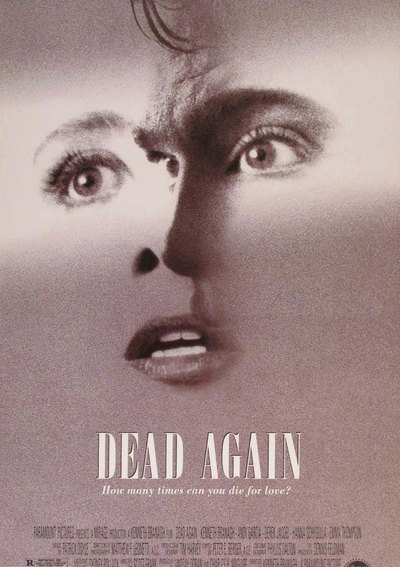
Dead Once again (1991)
107 minutes
Latest blog posts


Comments
Source: https://www.rogerebert.com/reviews/dead-again-1991
0 Response to "The Making of Dead Again Movie"
แสดงความคิดเห็น